 Neotokyo
 Citizens - S1 Traits and S2 Staking Weights
Neotokyo Citizens have different staking weights in the 2023 BYTES 2.0 design: S1 weights depend on Identity traits and Vault configuration, while S2 Citizens share a uniform starting weight. The selected lock and any deposited BYTES then affect the position, alongside the reward pool's configuration.
Identity Traits Behind S1 Weight
In the February 14, 2023 contract design, an S1 Citizen's Identity determines its starting staking score through the Credit Yield trait. The staker recovers that trait from the assembled Citizen's stored reward data and component Vault information. It then applies the point value that administrators configured for that trait. The NFT carries the Identity; the staking contract supplies the mapping from trait to score. Its calculation also applies the relevant Vault or class multiplier and selected timelock multiplier. A legacy reward-rate field therefore helps identify the underlying trait without specifying the holder's eventual BYTES 2.0 payment.
Vaults Inside and Alongside the Citizen
An S1 Citizen can qualify for a Vault multiplier through a component Vault or a separate Vault staked alongside it. An assembled Citizen contains references to its underlying components, including an optional Vault. A separate Vault remains its own NFT when the owner stakes it beside a Citizen that lacks a component Vault.
Vault Placement
The 2023 staker distinguishes a Vault already incorporated into the Citizen from one that the holder deposits separately.
A Vault Inside the Citizen
A component Vault supplies its configured multiplier through the Citizen's existing component relationship unless the holder requests an eligible Hand of the Citadel bonus. The staker does not require another Vault NFT for that association. The underlying Vault remains part of the assembled Citizen when the holder later withdraws the Citizen from escrow.
A Vault Alongside the Citizen
A separately staked Vault can supply the corresponding multiplier when the Citizen has no component Vault. The staker takes custody of that separate NFT and records its token ID. This route changes the staking association without requiring the holder to disassemble and rebuild the Citizen.
The Holder, the Staking Contract and the Reward Recipient
The Citizen holder supplies the NFT, the staking contract holds it in escrow and the BYTES 2.0 contract mints rewards to the staker's address. Escrow means the staking contract holds the deposited asset until the recorded staker withdraws it. Holding a membership NFT in a wallet and maintaining an active staking position are distinct states. The staking contract records the depositing address alongside each Citizen's points, lock expiry and linked deposits. That record connects participation with the address entitled to withdraw the asset. It also gives reward calculations the holder's aggregate points within the relevant pool.
Permitted administrators configure the score mappings, lock options and pool emissions. Their settings affect the calculation without changing the Citizen's underlying Identity.
Deposited BYTES and Per-Citizen Caps
Depositing BYTES 2.0 into an already staked Citizen adds point weight, subject to the cap that applies to that particular Citizen. The depositing address must have staked the target NFT. An unrelated holder cannot attach a deposit to someone else's recorded Citizen position.
The design expresses the additional contribution as one point per 200 BYTES. This contribution supplements the Citizen's existing weight. The deposit calculation does not multiply those added points by the Citizen's Vault or timelock multiplier.
Vaulted S1 Citizens use the configurable VAULT_CAP limit. S1 Citizens without a Vault and all S2 Citizens use NO_VAULT_CAP. Both limits apply per Citizen, including BYTES already deposited into that Citizen. They are not one shared allowance for the wallet. A deposit cannot exceed the applicable configured total. Neither field name establishes its current numerical value or a permanent relationship between the limits.
Lock Duration and NFT Availability
A selected timelock determines when the staker permits the Citizen's withdrawal and supplies the multiplier attached to that staking choice in the 2023 design. The contract configures lock options separately by asset type. An option available for S1 therefore does not automatically establish the same option for S2. The relevant term combines a duration with a point multiplier. No universal lock duration follows from the Citizen's name, appearance or series.
The multiplier comes from the selected option when staking begins. Simply leaving the NFT deposited does not create a continuously increasing multiplier. The 2023 design retains the selected bonus after the lock expires, while permitting withdrawal. Expiry therefore changes access to the NFT without automatically ending its reward participation. Deposited BYTES remains tied to the Citizen's withdrawal, so the lock also affects access to that linked balance.
Why Do Citizen Staking Rewards Change?
A Citizen's reward can change when its pool's configured emission rate or the total points held by competing stakes change. The staker divides the relevant pool's emissions using the recipient's share of that pool's points. More points can increase that share under otherwise unchanged conditions. Additional competing points reduce the share attributable to a fixed position. The emission schedule determines the token amount available for allocation, while the selected lock and Citizen configuration determine the position's weight.
A configured DAO share also affects the recipient's allocation. The staker calculates the reward due to the holder separately from the treasury's share. The BYTES 2.0 contract then mints each amount to its intended recipient. A pending reward calculation and tokens minted into the recipient's wallet represent different states. Neither a trait score nor a projected token quantity establishes a cash return on the NFT's purchase price.
Withdrawal of Linked Assets
After the recorded lock expires, the address that staked a Citizen can request its return together with the BYTES tied to that Citizen. The 2023 withdrawal functions check both the caller's recorded stake and the lock deadline. A reward claim alone does not return the NFT.
The 2023 BYTES 2.0 staking design prevents deposited BYTES from being withdrawn independently of their associated Citizen. Withdrawing an S1 Citizen also returns a separately staked Vault when present. A component Vault stays within the assembled Citizen's component relationship. An S2 withdrawal returns the Citizen and any BYTES deposited into it.
The lock deadline establishes withdrawal eligibility. It does not initiate an automatic transfer back to the wallet or disassemble the Citizen into its components.
S1 and S2 Weights in Separate Pools
S1 and S2 Citizens compete within separate reward pools, so a comparison of their point totals alone cannot establish which produces more BYTES. S1 begins with Identity-dependent weight and the applicable Vault or class modifier. S2 starts from a uniform base weight. Its selected timelock and deposited BYTES can still distinguish one S2 position from another. Cross-series comparisons need each pool's emission settings and total competing points as well as the individual position. A visually rarer NFT does not supply those missing pool inputs.
An S1 Vault Choice Before Commitment
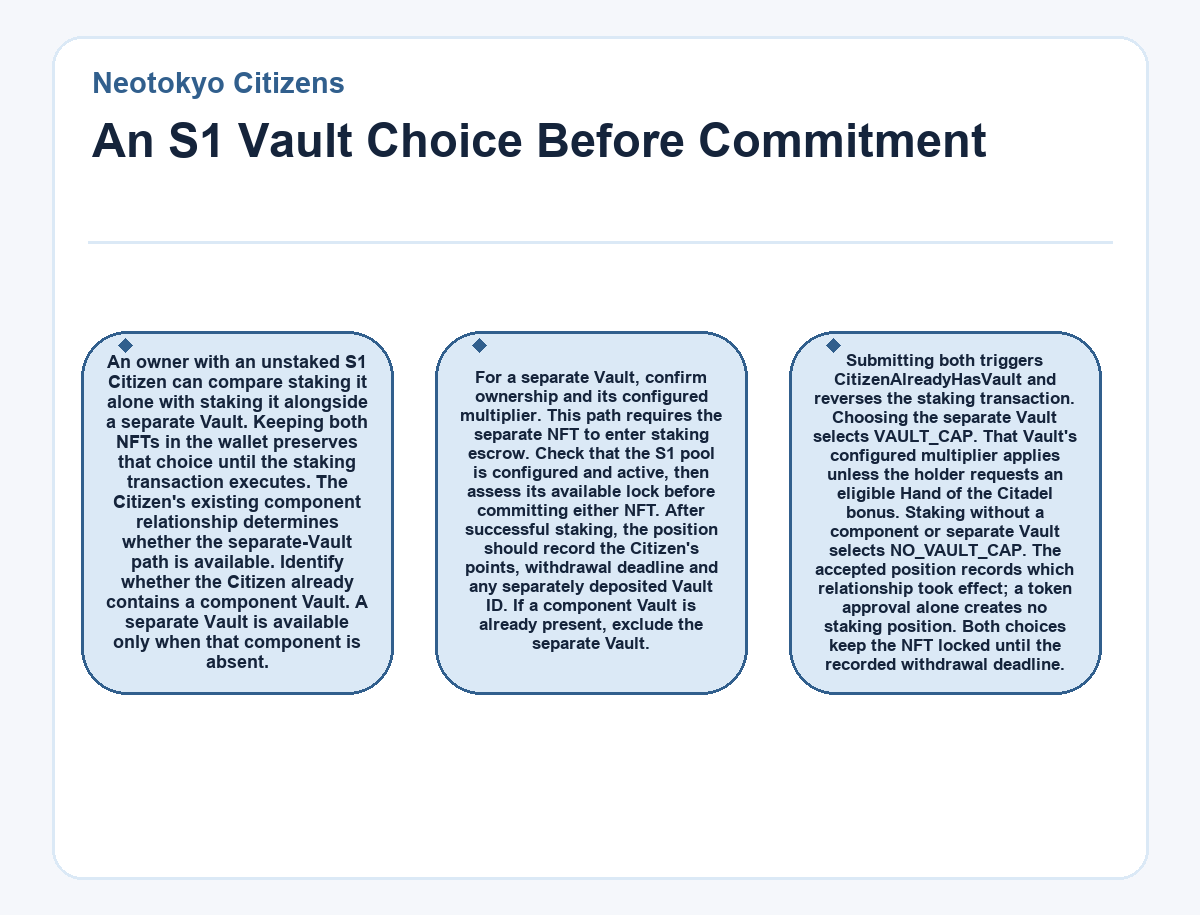
An owner with an unstaked S1 Citizen can compare staking it alone with staking it alongside a separate Vault. Keeping both NFTs in the wallet preserves that choice until the staking transaction executes. The Citizen's existing component relationship determines whether the separate-Vault path is available.
- Identify whether the Citizen already contains a component Vault. A separate Vault is available only when that component is absent.
- For a separate Vault, confirm ownership and its configured multiplier. This path requires the separate NFT to enter staking escrow.
- Check that the S1 pool is configured and active, then assess its available lock before committing either NFT.
- After successful staking, the position should record the Citizen's points, withdrawal deadline and any separately deposited Vault ID.
- If a component Vault is already present, exclude the separate Vault. Submitting both triggers CitizenAlreadyHasVault and reverses the staking transaction.
Choosing the separate Vault selects VAULT_CAP. That Vault's configured multiplier applies unless the holder requests an eligible Hand of the Citadel bonus. Staking without a component or separate Vault selects NO_VAULT_CAP. The accepted position records which relationship took effect; a token approval alone creates no staking position. Both choices keep the NFT locked until the recorded withdrawal deadline.
Class Bonuses and Actual Vault Associations
The Hand of the Citadel bonus uses the multiplier configured for the Vault tier labeled "?" when an eligible holder requests that bonus in the 2023 design. Eligibility follows the Citizen's component Identity class. The contract checks that class before applying the requested modifier. This branch selects the class multiplier in place of the ordinary Vault multiplier; it does not multiply both together.
The bonus alone does not set the position's Vault association. An eligible Citizen without an associated Vault remains under NO_VAULT_CAP. Its deposit capacity follows that recorded association even when the class bonus supplies its staking multiplier.
Everyday questions about Neotokyo Citizens
Do Item Caches and Land Deeds Add S1 Staking Points?
Item Caches and Land Deeds are assembly components, but the 2023 S1 staking calculation assigns no separate point term to either component. The calculation uses the Identity score, the applicable Vault or class multiplier and the selected timelock multiplier. Deposited BYTES supplies an additional point contribution.
Can an S1 Citizen Be Disassembled Into Its Components?
The owner of an unstaked S1 Citizen can use its disassembly function to recover its recorded component assets. The function returns the Identity, Item Cache and Land Deed, plus a component Vault when present, then burns the assembled Citizen token. Disassembly is separate from withdrawing the NFT from staking escrow.
What Does a Zero separate-Vault ID Mean for a Staked S1 Citizen?
A zero separate-Vault ID does not establish that an S1 position lacks a Vault. A Citizen with a component Vault leaves the separate-Vault field at zero in the 2023 staker. The position's hasVault flag distinguishes that state from a Citizen with no associated Vault.
Why Does a Citizen Stake Return an InactivePool Error?
An InactivePool error means the selected staking pool has not passed its configured starting time in the 2023 contract. The entry point separately checks whether the pool has any configuration. A valid Citizen token therefore does not establish that the selected pool is ready to accept a stake.
Is claimReward the Function That a Holder Calls Directly?
The 2023 staker allows only its configured BYTES contract to call claimReward. Holders claim through the BYTES 2.0 token's getReward entry point, which invokes the staker and mints the returned allocation. The supported legacy S1 Citizen getReward flow reaches that same token contract.
Does Claiming BYTES Restart a Citizen's Withdrawal Timelock?
A reward claim in the 2023 design updates reward-accounting timestamps without restarting the Citizen's withdrawal timelock, leaving the staking record's existing deadline in place whether the holder claims before that deadline or after the NFT becomes eligible for withdrawal.
Is an S1 Citizen an ERC-20 Token Like BYTES 2.0?
An S1 Citizen uses the ERC-721 NFT standard, while BYTES 2.0 uses ERC-20. The Citizen has a distinct token ID and component relationships. BYTES records a fungible balance. Depositing BYTES can supplement the Citizen's points without converting the NFT into an ERC-20 token.
Did the March 2023 Security Contest Cover Every Citizen Contract?
The March 2023 contest scope covered selected BYTES2 and NeoTokyoStaker functions, plus security issues in the legacy S1 reward-claiming flow. It excluded broader Citizen contracts and assembly logic. Centralization and malicious-administrator concerns also fell outside that scope, so the contest did not certify every administrative dependency.
Last updated ·