 Neotokyo
 designed BYTES to fund community tools over time
Neotokyo designed BYTES to help fund community tools through developer payments and a treasury that could support further building. Its Incentivized Building program connected proposed applications with leadership review and financial support. Builders could receive a share of the BYTES spent in their tools, while the token's treasury mechanisms could replenish development resources. These arrangements had different recipients and conditions. A token payment alone did not establish the builder's share or secure funding for ongoing maintenance.
The short version: Under the BYTES funding plan, developer compensation depended on tool payment terms, while treasury allocation determined support for later projects.
Builders, Tool Users and the Treasury
The proposed funding model connected builders with application development, users with BYTES spending and the treasury with resources for approved community work. Developers needed compensation for useful products. Members needed tools that supported their activities within crypto gaming. Leadership then decided how treasury resources should support further development.
The program's stated purpose was to strengthen collaboration. Member-built utilities were meant to support the wider network, including work on members' own gaming projects.
How Did Tool Spending Support Further Development?
The funding plan connected application spending with builder compensation and resources that the treasury could direct toward later community projects. A developer's agreed share could provide income after an initial release. Treasury receipts could support additional approved work. Both relationships depended on the actual payment arrangement. An application needed usage before a percentage of spending could produce continuing revenue. Treasury funds also needed an allocation decision before they supported another build.
Project Selection and Builder Compensation
Incentivized Building combined project selection with support for development and a proposed way for builders to earn from continued application use.
Eligibility Built Around Community Use
The announced criteria called for projects that used BYTES, improved the community and encouraged building, sharing and creation. Using the token was therefore part of the intended design, alongside a useful community function. A proposal still needed to explain what its application contributed.
Leadership Funding Decisions
The announced Incentivized Building process assigned project funding decisions to community leadership. Teams could submit projects for discussion and voting. Although the fund carried the DAO label, the process did not give every Citizen a vote on each allocation. Submission and funding approval remained different stages.
Payment Terms for Builders
Builder compensation could include a share of the BYTES spent within a supported project. The announcement described this arrangement as long-term payment. That connected developer income to subsequent use, while initial development support could help a project reach the point where users could spend tokens.
Tools Intended to Encourage Participation
The proposed tools connected BYTES with activities that members already wanted to perform, including sharing research and finding collaborators. An internal alpha board focused on exchanging potentially useful industry information. A job and skills board addressed hiring within the community. These proposals gave the token a purpose tied to participation, with different incentives for the people contributing information, building software or seeking services.
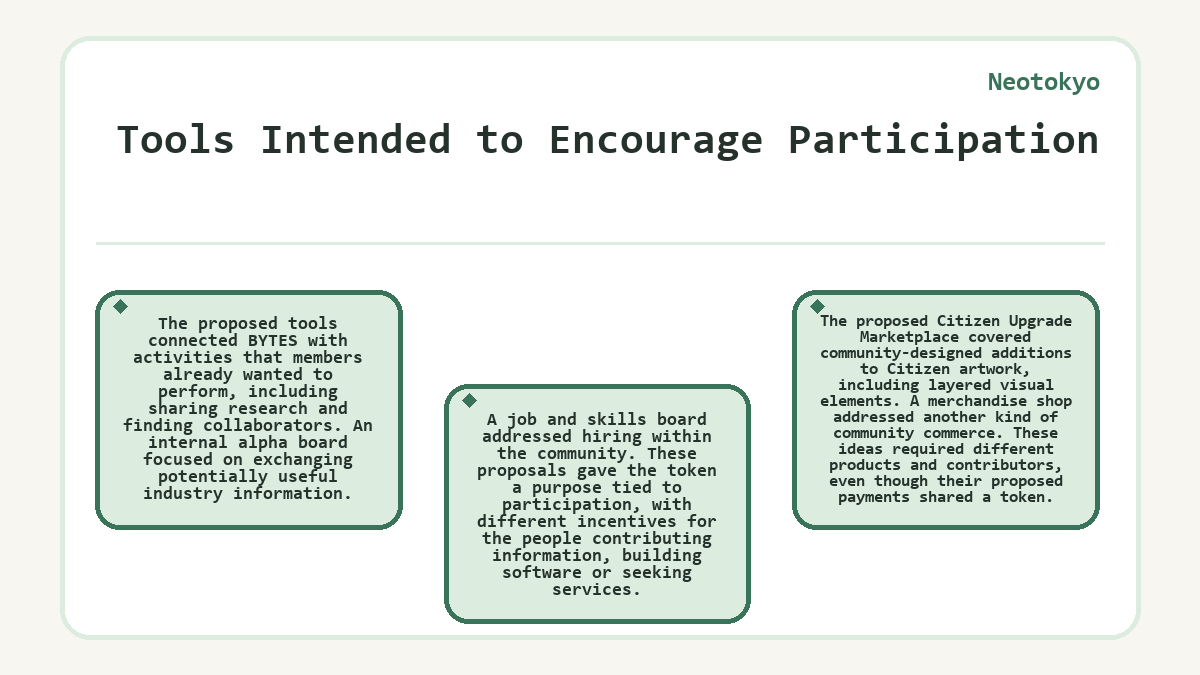
The proposed Citizen Upgrade Marketplace covered community-designed additions to Citizen artwork, including layered visual elements. A merchandise shop addressed another kind of community commerce. These ideas required different products and contributors, even though their proposed payments shared a token.
Treasury Replenishment in the BYTES 2.0 Design
The BYTES 2.0 contract version dated February 14, 2023 connected authorized token burns with treasury replenishment. This mechanism explained a specific supply change, separate from the commercial terms that compensated an application's builder.
Authorized Burns
In the BYTES 2.0 contract version dated February 14, 2023, an authorized burn reminted two-thirds of the burned amount to the treasury. A caller needed the contract's burn permission to invoke that function. The operation removed tokens from the specified holder before creating the treasury's share.
Supply After Reminting
Reminting meant that the amount removed from the holder exceeded the net reduction in total token supply. Before integer rounding, the remaining third represented that reduction. Treasury tokens remained available for later use, so a burn through this function did not permanently remove the whole amount from circulation.
A Tool Charge and Its Treasury Effect
A tool charge illustrates how the burn mechanism could replenish development resources while reducing supply. Consider a hypothetical application that routes a charge of 264 BYTES through the authorized burn function in that February 2023 design.
The burn removes 264 BYTES from the paying holder's balance. The contract then remints 176 BYTES to the treasury because two-thirds of 264 is 176. Total supply falls by 88 BYTES across those operations. The treasury receives tokens that it can subsequently allocate; the burn function itself makes no payment to the tool's developer.
This outcome requires the assumed burn route and the stated contract behavior. A developer's payment would need its own arrangement. Changing the charge changes the calculated amounts, subject to integer rounding. A payment route that only transfers tokens does not produce this burn-and-remint outcome.
Reward Emissions and Development Budgets
The staking design distributed BYTES emissions among participants according to their shares of points within separate pools. S1 Citizens, S2 Citizens and liquidity-provider tokens occupied distinct pools in the March 2023 staking specification. These emissions supplied tokens separately from revenue earned through useful applications. Distributing additional BYTES did not establish that a tool had attracted paying users. Development budgets therefore needed to distinguish token issuance from spending that returned tokens to the treasury. Configured reward rates and participating stakes could change reward amounts.
Continued Revenue and Tool Maintenance
Revenue sharing gave developers an incentive to keep applications useful after release because later spending could continue to generate builder income. The amount available through that arrangement still followed usage. A percentage-based payment could produce little income when spending was low. Initial support and subsequent revenue therefore addressed different periods of a project's life. Neither arrangement alone specified the continuing work that a builder would deliver, the people providing support or an update schedule. Those commitments required their own terms.
Announcements and Delivered Applications
Tool delivery and token-infrastructure rollout had different statuses in the 2023 community update. It reported the WL Marketplace and Merch Store among delivered community projects. The same update described BYTES 2.0 deployment as an outstanding priority.
The earlier Incentivized Building announcement also distinguished an active application process from desired tools. Its job board and alpha board appeared among projects that leadership wanted to see. Opening submissions established a route for proposals, while each application's release required its own development progress. Announcing support for building did not make every listed concept available.
Those statements described their respective development periods. Their projected timings did not establish a continuing release deadline, and historical plans alone do not determine an application's present availability.
Token Transfers, Burns and Treasury Rewards
The funding design involved different token movements with different effects on balances and supply.
Spending and Supply
A standard ERC-20 transfer moves existing tokens between balances. It does not itself invoke the separate authorized burn function. Payment terms determine how a tool directs user spending and compensates its builder. Consequently, spending BYTES and reducing the BYTES supply describe different operations, even when an application connects them.
Emissions Allocated to the Treasury
The 2023 staker also defined a configurable treasury share of reward emissions. The BYTES token contract minted the claimant's reward and the treasury allocation to their respective recipients. This allocation concerned newly emitted rewards. It did not describe a deduction from the holder's entire BYTES balance or establish the application's developer payment.
Ongoing Funding Under Changing Conditions
Continued funding depended on application use, payment terms and treasury allocation, while permitted managers could also change settings in the 2023 contracts. The token contract allowed authorized changes to its treasury and staking-contract addresses. The staker exposed configurable emissions and treasury reward allocations. Those controls meant later configuration could change future token flows. If later contracts or payment terms differ, their rules determine the funding relationship.
Neotokyo - common questions
Was the Proposed Developer Revenue Share a Fixed Rate Across All Tools?
The Incentivized Building proposal did not establish one developer rate for every application. Its merchandise-store discussion used a 5% share of sales in BYTES as an illustrative arrangement. That figure described a possible builder payment, rather than a universal tool fee. The amount received by a particular developer depended on that project's agreement and the spending to which its percentage applied.
Could the Treasury Burn BYTES Instead of Funding Another Project?
The tokenomics plan allowed the treasury to choose between supporting community building and burning its BYTES. Treasury receipts therefore did not represent an automatic commitment to spend those tokens on another application. Allocation decisions affected whether receipts supported development or reduced supply through a subsequent burn. This choice was separate from the remint that replenished the treasury during an authorized BYTES 2.0 burn.
Did the Funding Program Require Citizens to Work for Neotokyo?
Incentivized Building encouraged selected internal projects without making employment within Neotokyo the purpose of membership. The program's stated aim was to strengthen a network whose members could develop their own crypto gaming projects. Building a community utility was one supported form of participation. The announcement did not present the program as a general job placement scheme or promise each Citizen paid development work.
How Would Research Contributors Receive BYTES Through the Proposed Alpha Board?
The alpha board proposal used BYTES tips and upvotes to reward people who shared useful research. Its builder could receive a separate share of the BYTES tipped through the board. That distinguished compensation for information from compensation for developing the application. The proposal described an incentive arrangement, so it should not be read as a fixed payout for every post or confirmation that the board had launched.
Would the Proposed Merchandise Shop Rely on One Production Team?
The merchandise proposal allowed multiple community teams to sell approved products in BYTES. Approval concerned merchandise quality, while teams could handle their own offerings. A developer's share for building the shop was a separate proposed payment. The illustrative percentage for that work did not establish identical commercial terms for every seller.
Does an S1 Vault Multiplier Specify a Tool builder's Revenue Share?
An S1 Vault multiplier affected staking points in the 2023 staking design, while builder compensation belonged to an application's payment arrangement. The former changed a Citizen's share of pool emissions under the configured rules. Incentivized Building described the latter through a share of BYTES spent in a supported project. A staking multiplier therefore supplied no developer commission rate for that application's agreement.
Did Upgrading BYTES 1.0 Automatically Pay the Development Treasury?
The upgrade function in the BYTES 2.0 contract dated February 14, 2023 burned the caller's old tokens and minted the same amount of replacement tokens to that caller. It did not invoke the new token's separate treasury-reminting burn function. Applying the two-thirds treasury calculation to an old-token upgrade would confuse these operations. The treasury allocation discussed for authorized BYTES 2.0 burns was a different mechanism.
What Treasury Risks Fell Outside the March 2023 Security Contest?
Centralization and malicious administrator risks fell outside the March 2023 contest's stated scope. The contest covered parts of BYTES2.sol and NeoTokyoStaker.sol, including only specified functions. Those exclusions mattered because authorized accounts could configure consequential treasury-related settings. The contest's existence did not establish protection against every misuse of those powers or confirm equivalent review of every proposed community application.
Last updated ·